The SelectGlobal Process: How Allied-Nation Manufacturers Enter the U.S. Market
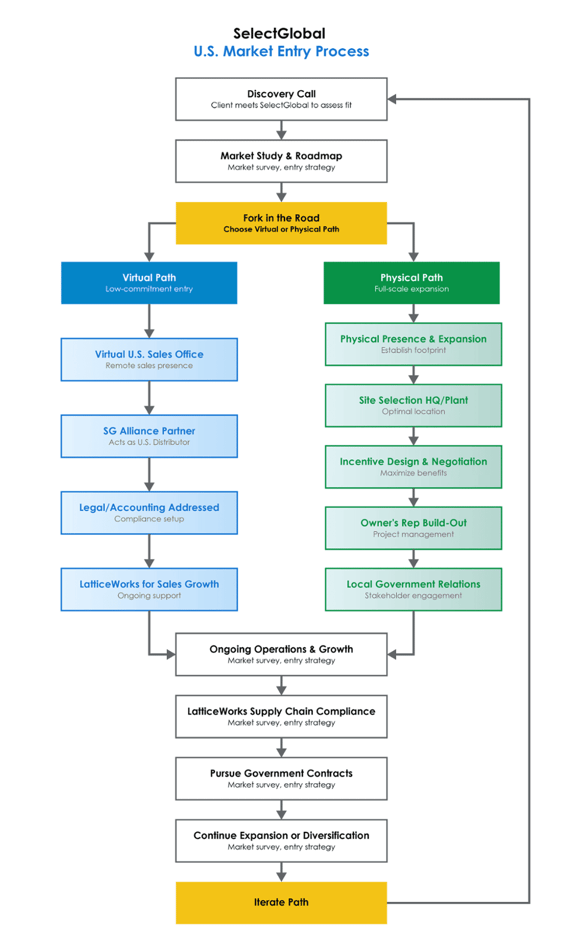
The Fork Framework is SelectGlobal's proprietary decision architecture for U.S. market entry. It structures every engagement from the first Discovery Call through sustained U.S. operations, with one point of accountability at every stage. Established international manufacturers do not guess at the right path. They run the Framework.
SelectGlobal works exclusively with established companies, not early-stage startups. The client profile is a founder-led allied-nation manufacturer with proven products, validated home-market demand, and the capital to execute a structured U.S. entry.
The Five Stages
Stage 1: Discovery Call
Strategic Fit and Readiness Assessment
The Discovery Call is a 90-minute structured assessment, not a sales conversation. SelectGlobal evaluates company readiness, product viability, and strategic fit for U.S. market entry across five dimensions: product-market fit for American customers, competitive positioning and differentiation strength, organizational capacity for expansion, capital availability, and timeline requirements.
The session answers one question before any fees are committed: does U.S. market entry make strategic sense for this company at this stage of its development?
If the answer is yes, the engagement moves to Stage 2. If the answer is no, SelectGlobal says so. That is what one point of accountability means in practice.
Stage 2: Market Study & Roadmap
Custom Entry Strategy Based on Research and Analysis
The Market Study and Roadmap is the analytical foundation of the engagement. SelectGlobal develops a structured entry strategy built on competitive research, regulatory analysis, and site-specific opportunity mapping. The output identifies the optimal entry path, target markets, partnership requirements, and capital deployment sequence.
Four deliverables anchor every Market Study: a competitive landscape analysis, a regulatory and compliance roadmap, preliminary site and partner recommendations, and financial projections with capital requirements.
The Roadmap is what moves a manufacturer from strategic intent to structured decision. It is also what prepares the company for the Fork Framework decision point in Stage 3.
Stage 3: The Fork Framework™ Decision Point
Virtual vs. Physical Entry — Choosing Your Path
After completing your Market Study, you reach a structured decision point driven by four critical criteria:
Capital — What can you responsibly commit to U.S. market entry?
- Timeline — How quickly do you need revenue-generating operations?
- Risk Appetite — Do you validate demand first or commit to full infrastructure?
- Infrastructure Needs — Does your product or service require physical facilities to win customers?
Based on these criteria, you choose between two distinct pathways:
Virtual Path or Physical Path. Choosing Your Entry Strategy.
After completing the Market Study and Roadmap, every company reaches the same structured decision. Four variables determine the answer: capital availability, timeline, risk tolerance, and infrastructure requirements. The Fork Framework maps those variables to the right path. The choice is analytical, not intuitive.
Virtual Path ($75K to $150K, 3 to 6 months)
Low-commitment market validation using U.S. distributors, sales offices, or service partnerships. The Virtual Path is the right choice for companies testing demand, launching services, or entering with products that do not require physical facilities to reach the first customer. SelectGlobal establishes a virtual U.S. presence, coordinates alliance partner relationships, integrates the LatticeWorks ecosystem, and manages legal and accounting orchestration on the company's behalf.
Physical Path ($2M to $10M+, 12 to 24 months)
Full-scale infrastructure commitment with local staff, manufacturing facilities, or U.S. headquarters operations. The Physical Path is the right choice for companies ready to establish permanent American operations. SelectGlobal manages site selection, incentive design and negotiation, regulatory and tax readiness, owner's representative build-out oversight, and local government relations from a single point of accountability.
Both paths converge. Neither is permanent. A company that enters on the Virtual Path and validates demand can transition to the Physical Path within the same engagement framework.
Stage 4: Convergence — Sustained Operations
Where Both Paths Unite
Whether a company entered on the Virtual Path or the Physical Path, both converge at the same point: sustained U.S. operations powered by the LatticeWorks ecosystem. At Stage 4, SelectGlobal transitions from market entry orchestrator to ongoing operations partner.
Ongoing Operations and Growth
Production ramp-up, workforce expansion, and performance optimization support ensure that American operations scale systematically rather than reactively. SelectGlobal coordinates the LatticeWorks Constellation throughout this phase, maintaining the single point of accountability that governed the entry process.
The Platypus Advantage
For Physical Path clients with manufacturing operations entering federal procurement, the Platypus Advantage is SelectGlobal's AI-enhanced intelligence layer for supply chain compliance. It tracks domestic content requirements, Buy American Act adherence, and federal procurement qualification in real time, mapping regulatory obligation against operational reality so clients know where they stand before a contracting officer asks the question.
Government Contracts Pathway
Eligibility assessment, SAM.gov registration, bid preparation, and compliance guidance to access federal, state, and municipal procurement opportunities. This is where the defense-adjacent positioning of an allied-nation manufacturer becomes a competitive asset rather than a compliance burden.
Continue Expansion
New regions, upgraded facilities, acquisitions, or product line extensions, all supported by the same LatticeWorks ecosystem that powered the initial entry.
Stage 5: Reapply the Fork Framework™
Scale, Expand, or Diversify with Discipline
Your first U.S. market entry is rarely your last. As operations mature, new opportunities emerge: additional regions, expanded product lines, acquisitions, or vertical integration. When they do, the Fork Framework is reapplied. The same four variables, the same structured decision, the same single point of accountability.
Expansion scenarios that trigger a second Fork decision include geographic growth into new states or regions, product line diversification, vertical integration across suppliers or distribution, strategic acquisitions, and government contracting pipeline development.
Disciplined growth means every expansion cycle runs through the same analytical framework as the first. SelectGlobal clients do not accumulate U.S. market positions reactively. They build them the same way they built the first one.
One Point of Accountability, Every Step of the Way
From the first Discovery Call through sustained U.S. operations, SelectGlobal owns the outcome. No fragmented handoffs. No rotating cast of specialists who disappear between stages. One principal-led firm coordinating every dimension of your U.S. market entry through the LatticeWorks Constellation of 250+ municipalities and 68+ trade commissioners.
The Fork Framework determines the path. The LatticeWorks Constellation executes it. SelectGlobal is accountable for both.
Schedule your Discovery Call at selectglobal.net or contact michael@selectglobal.net directly.